

If you are lucky, there’s a smell that hits you first. Old wood, paint, something faintly musty, the particular atmosphere of a rural gallery. It’s nothing like walking into a city gallery. Regional spaces don’t try to, and can’t afford to, impress you before you’ve seen the work.
I’ve spent a lot of time wandering through regional galleries across NSW for this magazine, and that smell has become something I look forward to. It signals a different kind of encounter, slower, less performative, more honest. The kind of place where you find yourself stopped mid-step in front of something you weren’t expecting to be moved by.

That happened to me in a conversation with Jade Holland, a Wiradjuri and Gomeroi woman who grew up on Bundjalung Country, standing in front of her own work, featured below.
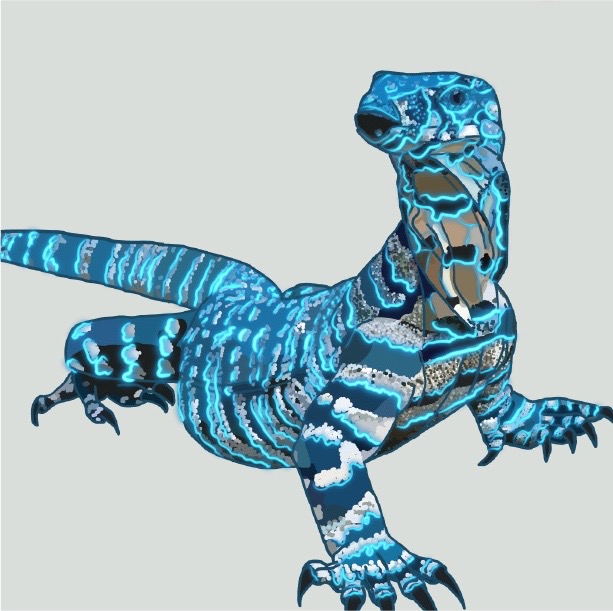
Beach goanna – a culturally important totem for a Saltwater woman of Budawang / Dhurga / Yuin Country with Burrier/Dharawal ancestry.
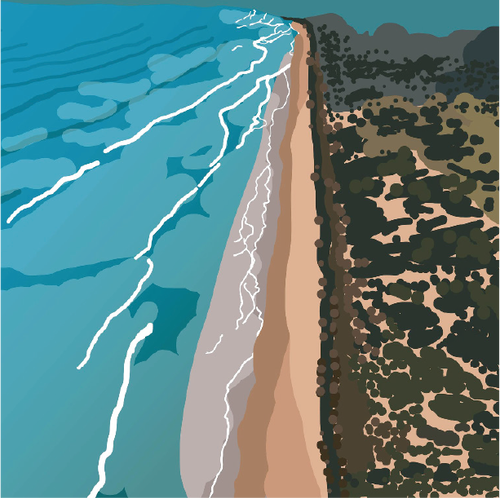
There are few things better than the artist being right there, willing to stop and share the story behind the work. Jade’s piece, a beach goanna rendered in Adobe Illustrator, intricate and striking, gave us plenty to talk about. She wasn’t explaining the work so much as describing the totem itself. The goanna comes to life in Jade’s artwork, a living breathing totem carrying the deep connection between artist, country and story across time. What struck me was something Jade said herself, that the digital process wasn’t a move from tradition, it was part of its evolution. Depicting a creature that has lived on this land for tens of thousands of years, now rendered in pixels on a screen. These are the encounters you don’t get in a city gallery. And it’s exactly why regional spaces are worth championing.
Jade’s work is one story. Across regional NSW, and regional Australia more broadly, there are countless others waiting in spaces most people drive past without stopping.
Regional galleries shouldn’t be a footnote to Australia’s cultural story. They should be the story. Spaces that have been showing up for their towns, often underfunded and community driven.
Most of these spaces run on tight budgets, volunteer hours, and a stubborn belief that their community deserves a cultural life.
For many regional artists they are a lifeline. Not only for exposure but for connection. Anyone who has spent time living regionally or remotely understands that particular kind of isolation. In a country this vast, the distance between people and culture can be exhausting. Regional galleries push back against that. They offer a means of income, yes, but also a sense of belonging to something larger than the space itself.
If you’re travelling through regional Australia, make time to visit a local gallery. Buy something if you can. These spaces survive on exactly that kind of support, and what they offer in return, connection to place, to story, to artists making work that actually means something, is worth far more than the drive.
For more on these unique spaces, check out REGIONAL ART SPACES: AUSTRALIA’S HIDDEN GEMS. Support a rural gallery on your next adventure and help sustain art and communities across the country.
Sarah Garnett
Sarah Garnett is a cultural journalist and editor specialising in food, travel, and place-based storytelling. A qualified chef with experience working in remote communities including Mornington Island in Queensland, she brings a grounded understanding of food, culture, community, and environment. As editor of independent publication Speak Easy Magazine, she writes on art and culture, hospitality, design, and contemporary Australian life through an editorial lens shaped by lived experience. Her work is also driven by a commitment to keeping rural tourism visible and alive through thoughtful coverage of regional places, people, and experiences.


